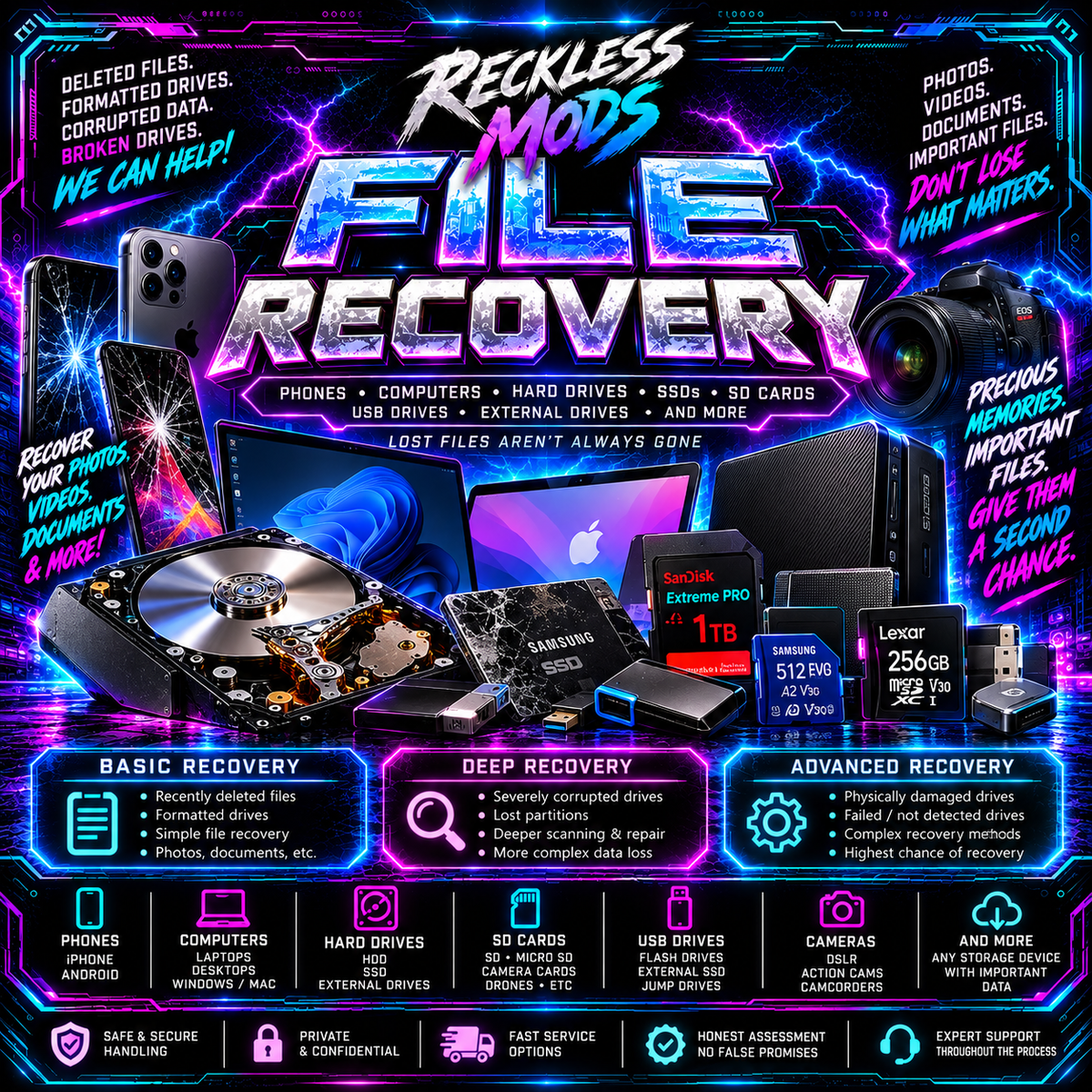
File Recovery Service
Reckless Mods — File Recovery Services
1. Basic File Recovery
Difficulty: Easy | Complexity: Low
Basic File Recovery is designed for simple data-loss situations where files have been accidentally deleted or are still accessible through a functioning storage device. This service uses standard recovery tools to scan supported devices and attempt to locate recoverable files.
What this service can help recover
-
Accidentally deleted photos, videos, and documents.
-
Lost files from USB flash drives and SD cards.
-
Recently deleted files from accessible storage devices.
-
Files that have become difficult to locate but remain recoverable.
How complex is it?
This is our simplest recovery service. Most jobs involve scanning the device, locating recoverable files, and copying them to a separate storage destination. The process is generally straightforward when the device is functioning correctly and the data hasn't been overwritten.
Best for: Customers who have accidentally deleted files and need help getting them back.
Why recovery may not be possible
Even a simple recovery job can fail if the deleted data has already been overwritten by new files or other system activity. Some devices also permanently erase deleted data through built-in storage management processes. The sooner a device is taken out of use after data loss, the better the chances may be of recovering the original files.
Recovery depends on the condition of the device and whether the original data remains intact.
2. Deep File Recovery
Difficulty: Moderate | Complexity: Medium to High
Deep File Recovery is intended for more complicated data-loss situations where a standard scan may not be sufficient. We use more thorough scanning methods to search for files that are no longer easily visible or accessible through the normal file system.
What this service can help recover
-
Files lost after accidental formatting.
-
Missing files from corrupted or damaged file systems.
-
Lost folders and files from inaccessible partitions.
-
Photos, videos, documents, and other supported file types.
-
Files that basic recovery scans were unable to locate.
How complex is it?
Deep recovery can take considerably longer than basic recovery. The process may involve extended scans, file-system analysis, and attempts to reconstruct lost file information. Recovered files may have incomplete names, missing folder structures, or damage that prevents them from opening correctly.
Best for: Customers who have formatted a drive, lost access to files, or experienced logical file-system corruption.
Why recovery may not be possible
Formatting a drive, continuing to save files, installing software, downloading content, or using the device normally after data loss can reduce the chances of recovery. New information may overwrite the exact storage locations where the original files were kept.
The amount of time since the files were lost can matter, but elapsed time alone does not determine whether recovery is possible. What matters more is how much the storage device has been used, whether new data has overwritten the lost information, and whether the device has performed operations that permanently discard it.
For example, a file deleted several months ago might still be recoverable from a storage device that has barely been used. A file deleted only minutes ago might be unrecoverable if its storage space has already been overwritten or securely erased.
Do not continue writing new data to a device after data loss. New data may overwrite files that could otherwise be recovered.
3. Advanced File Recovery
Difficulty: Hard | Complexity: High
Advanced File Recovery is designed for complex cases that require more detailed analysis of a storage device. This service may involve disk imaging, partition reconstruction, advanced file carving, and specialized recovery techniques for severe logical corruption.
What this service can help recover
-
Files from severely corrupted file systems.
-
Data from lost or damaged partition structures.
-
Files that remain undetected after standard and deep scans.
-
Data from storage devices that are intermittently readable, when safe to access.
-
Difficult recovery cases requiring additional analysis and specialized tools.
How complex is it?
Advanced recovery can require substantial technical work and extended processing time. Each case must be evaluated individually, and some files may be partially damaged or permanently unrecoverable. Where appropriate, recovery attempts are performed on a disk image or working copy rather than directly on the original device.
This package covers advanced software-based recovery attempts. It does not automatically include physical drive repairs, cleanroom procedures, replacement hardware, or specialist laboratory services.
Best for: Customers with serious logical data-loss problems that cannot be addressed through standard recovery methods.
Why recovery may not be possible
Advanced techniques can locate data that ordinary recovery tools miss, but they cannot guarantee that the original information still exists in a recoverable form.
If the original storage space has been overwritten, securely erased, or discarded by the device's storage-management system, software generally cannot reconstruct the original contents. Severe corruption may also leave file fragments incomplete or destroy information needed to rebuild the original files.
Solid-state drives (SSDs) can be particularly challenging because features such as TRIM and internal garbage collection may permanently clear deleted data blocks. This can happen even when the customer has not intentionally saved new files after deletion.
If a device has physical damage or is repeatedly disconnecting, further attempts to scan it may make the situation worse. Such devices may need to be evaluated by a specialist data recovery laboratory before proceeding.
Advanced recovery does not guarantee success. Devices with physical damage, failing drive components, or other hardware faults may require a specialist data recovery laboratory.
Important Information for All Recovery Services
No Guaranteed Recovery
All recovery services are attempts to retrieve data that remains available in a recoverable form. Not every deleted, lost, formatted, or corrupted file can be restored. Recovery results depend on the device, the type of data loss, the condition of the storage media, and whether the original data has been overwritten, erased, or otherwise destroyed.
Time Since Data Loss and Device Usage
The amount of time that has passed since a file was lost is not the only factor that determines recovery success. A device that has remained unused may retain recoverable data for a long period, while a device that continues to be used can lose recoverability much sooner. Operating system activity, updates, downloads, application installations, and ordinary file operations can all affect the outcome.
Protect Your Data
If files have been lost, stop using the affected device as soon as possible. Avoid installing recovery software on the affected drive, downloading files to it, formatting it again, or attempting repeated repairs. When appropriate, a recovery attempt should be performed on a sector-by-sector image or working copy to reduce the risk of further data loss.
Customer Privacy
Recovered files are handled confidentially and are accessed only as necessary to perform the authorized recovery. Customers should disclose any special privacy requirements before work begins.
Separate Storage May Be Required
Customers may need to provide an external hard drive, USB drive, or other suitable storage destination for recovered files. Recovered data should not be saved back to the same device from which it is being recovered.
Physical Damage
Clicking hard drives, liquid-damaged devices, failing storage components, and devices with suspected physical damage may require specialist assessment. Continuing to operate a physically failing drive can cause additional damage and reduce the chances of recovery.
Customer Authorization
Recovery work begins only after the customer has authorized the service and any applicable charges. Additional work outside the original service scope requires approval before proceeding.
Recovery Results and File Integrity
A successful scan does not necessarily mean every file has been restored correctly. Some files may be incomplete, corrupted, missing their original names, or unable to open. Where possible, recovered files should be checked for readability and integrity before the recovery job is considered complete.